The Benefits and Side Effects of Decaf Coffee, by the Evidence
Decaf coffee provides antioxidants and may support liver health, blood sugar control, hydration, and reduced acid reflux. Its low caffeine content can also reduce caffeine-related sleep disruption and anxiety. Evidence is strongest for antioxidant retention, liver health, blood sugar effects, and reflux. Gut and inflammation benefits remain less certain.
Decaf coffee is safe to drink every day for most adults. Common myths claim decaf coffee loses all its health benefits, dehydrates you, and disrupts sleep. Other myths say it causes anxiety, raises blood pressure and heart rate, raises blood sugar, and provides no useful antioxidants. Decaf retains many beneficial compounds while removing about 97% of the caffeine found in regular coffee. It typically contains only 2–15 mg of caffeine per cup. About 2–5 cups of decaf coffee per day can provide a steady intake of coffee's antioxidants and beneficial compounds. Most feared side effects of decaf coffee are specific to unfiltered brewing or come only from the caffeine decaf lacks.
The following table summarizes the ten most studied decaf coffee benefits, what drives each one, and how strong the evidence is.
| # | Benefit | What drives it | Evidence strength |
|---|---|---|---|
| 1 | Liver health | Chlorogenic acid, polyphenols | Direct decaf study |
| 2 | Blood sugar | Chlorogenic acid | Decaf trial evidence |
| 3 | Antioxidants | 20 to 25% of phenolics retained | Direct decaf study |
| 4 | Hydration | Trace caffeine, no diuresis | Decaf study |
| 5 | Gut health | Polyphenol prebiotics | Mechanistic only |
| 6 | Acid reflux | Lower acid trigger load | Decaf crossover |
| 7 | Sleep | Caffeine far below sleep threshold | Dose inference |
| 8 | Anxiety | Caffeine below panic dose | Dose inference |
| 9 | Inflammation | Polyphenol immune effects | Cohort + assay |
| 10 | Pregnancy safety | Ritual minus caffeine | Cochrane review |
TL;DR
Decaf coffee delivers the upside of coffee without the stimulant, because the chlorogenic acids behind the liver, blood sugar and anti-inflammatory links survive decaffeination. The caffeine that causes jitter, reflux and lost sleep is what gets removed.
1. Decaf Coffee Supports Liver Health
Decaf coffee supports liver health through gene-level effects of its chlorogenic acids, not through caffeine. A healthy liver processes fats without letting them build up. That buildup, left alone, can progress to inflammation, then scar tissue, then cancer. A 2021 study by Stefania Di Mauro in Nutrients tested decaf against it. In a mouse model, decaffeinated coffee prevented the fatty buildup, curbed weight gain, and pulled a scarring marker back to healthy levels. In plain terms, it stopped the damage before the scarring stage. It lowered blood glucose and cholesterol too. Every one of those effects traced to caffeic acid and the bean's other antioxidants, and none to the stimulant.
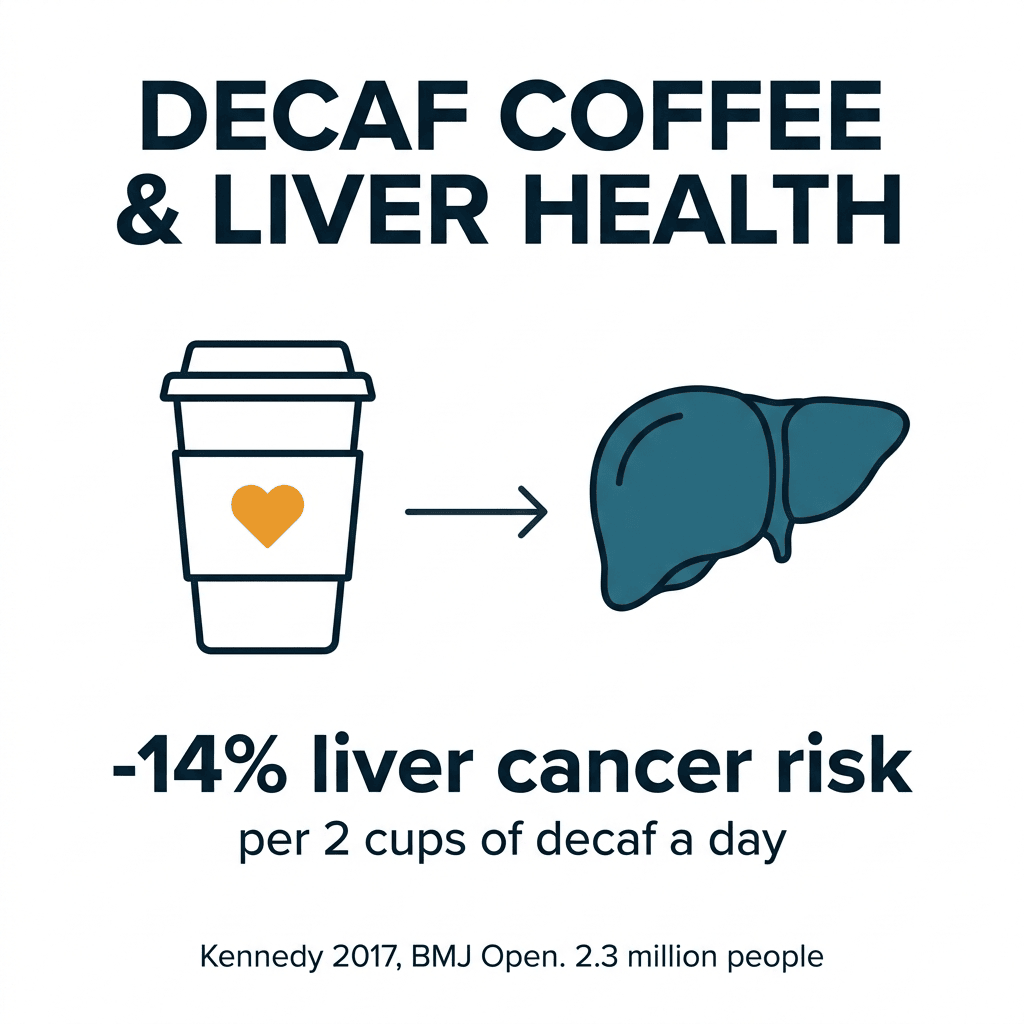
The benefits of decaf coffee for liver health were quantified in a 2017 meta-analysis by Oliver Kennedy in BMJ Open. It pooled 2.3 million people and tied each 2 cups of decaf a day to a 14 percent lower risk of liver cancer. That protection held across every stage of liver disease, and it did not depend on caffeine, since caffeinated coffee tracked the same direction. A separate 12-week trial by Federico Salomone in Translational Research fed decaffeinated espresso to fatty-liver rats and cut steatosis, inflammation, and fibrosis.
2. Decaf Coffee Helps Manage Blood Sugar
Decaf coffee helps manage blood sugar by improving insulin sensitivity in controlled trials. Insulin sensitivity is how readily the body's tissues take up glucose in response to insulin. The higher it is, the less insulin the body needs to keep blood sugar steady. In a randomised crossover of 17 healthy men, decaffeinated coffee improved that response against water without changing gut-hormone levels, per a 2018 study by Caio Reis in the British Journal of Nutrition.
The blood-sugar effect of decaf coffee traces to chlorogenic acid, the phenolic that survives decaffeination. The doses that move glucose are now well mapped. A 2017 trial by Laura Zuñiga in the Journal of Medicinal Food gave 1,200 mg of chlorogenic acid a day for 12 weeks. Insulin sensitivity, scored on the Matsuda index, rose from 1.98 to 2.30, and fasting glucose fell alongside it. In patients, a 2023 trial by Siti Lestari gave decaffeinated green coffee extract to 26 people with type-2 diabetes against 26 controls for 3 weeks and dropped mean fasting glucose from 144.7 to 92.23 milligrams per decilitre (mg/dl), using a concentrated supplement rather than a brewed cup. At the population scale, a 2014 Diabetes Care meta-analysis by Ming Ding pooled 1.1 million people and found each daily cup of decaf tied to a 6 percent lower risk of type-2 diabetes. The full breakdown covers decaf coffee and blood sugar in more depth.
Decaffeinated green coffee extract cut mean fasting blood glucose from 144.7 to 92.23 mg/dl over 3 weeks. The Medical Journal of Malaysia (2023) trial ran in 26 type-2 diabetes patients against 26 controls, on a concentrated extract rather than brewed decaf.
3. Decaf Coffee Delivers Antioxidants Without the Caffeine
Decaf coffee retains most of coffee's phenolic antioxidants after decaffeination, with measured retention ranging from about 79 percent of total phenolics down to 20 to 25 percent of the fraction the gut can absorb. Those antioxidants are chlorogenic acids and other hydroxycinnamic acids, the compounds that give coffee most of its health value. A 2013 study by Charlotte Mills in Food Chemistry mapped how much of each a cup holds. Mills measured 27 to 121 milligrams (mg) of chlorogenic acid in a 200 millilitre (ml) brew, with roast degree the main thing that lowered it. The stimulant leaves; the antioxidants largely stay, per a 2016 study by López-Froilán in Food & Function.
Decaf coffee's antioxidant load was measured head to head against regular coffee in a 2010 study by Rita Alves in the Journal of Agricultural and Food Chemistry. It found decaf kept about 79 percent of regular's phenolics, 324 against 410 mg per 30 ml cup, with radical-scavenging activity at 32 against 38 percent. In practice, a decaf cup neutralises free radicals nearly as well as a regular one. So the everyday oxidative-stress defence coffee is known for stays largely intact in decaf. Those antioxidants act inside the body, not just in the cup. A 2015 study by Johanna Gostner in the Journal of the American College of Nutrition showed filtered decaf suppressed an inflammatory signalling pathway in human immune cells. The more decaf extract they added, the stronger the suppression. That dose-response is what tells you the compounds stay biologically active after the caffeine is gone.
Antioxidants retained after decaffeination
4. Decaf Coffee Counts Toward Daily Hydration
Decaf coffee counts toward daily hydration, because its 2 to 15 milligrams (mg) of caffeine per cup sits far below any diuretic threshold. A diuretic is anything that makes the body shed more water, and for caffeine that effect only begins at 250 to 300 mg in one sitting, per a 2003 review by Ron Maughan in the Journal of Human Nutrition and Dietetics. Even that holds only in people who have avoided caffeine for days. Standard servings, and decaf far more so, produce no diuresis at all.
Decaf coffee's hydration was tested against water directly in a 2014 PLoS ONE trial by Sophie Killer. Fifty men drank four 200 millilitre (ml) cups of coffee a day for 3 days, then the same volume of water. The two showed no difference in total body water or 24-hour urine output. A cup of decaf is essentially that same water with a trace of stimulant. It hydrates like water while still delivering coffee's antioxidants, so for most people a cup of decaf counts fully toward the day's fluid.
97%
Caffeine removed in decaffeination, by industry convention
15 mg
Max caffeine per decaf cup
95 mg
Caffeine in a regular cup
5. Decaf Coffee Supports Gut Health
Decaf coffee supports gut health through prebiotic polyphenols that survive decaffeination. A prebiotic is a substrate that gut microbes selectively feed on for a health benefit, as a 2017 expert panel led by Glenn Gibson defined it in Nature Reviews Gastroenterology & Hepatology. The chlorogenic acids that feed beneficial gut bacteria stay in the cup after the caffeine is stripped. Because they survive, decaf can still nourish the gut the way regular coffee does.
Decaf coffee's chlorogenic acids were tested as a prebiotic in a 2015 study by Charlotte Mills in the British Journal of Nutrition. It fed human gut bacteria 80.8 mg of the acid, the amount in a strong coffee. Bifidobacterium rose significantly within 10 hours, while the caffeine passed through untouched. That rise matters, because Bifidobacterium is a friendly species that strengthens the gut barrier and tempers inflammation. Since chlorogenic acid drives that growth and caffeine plays no part, the effect carries over to decaf just as well. No decaf-specific microbiome trial exists yet, so treat this as plausible rather than proven, and the gut-health case is covered separately.
6. Decaf Coffee Is Gentler on Acid Reflux Than Regular Coffee
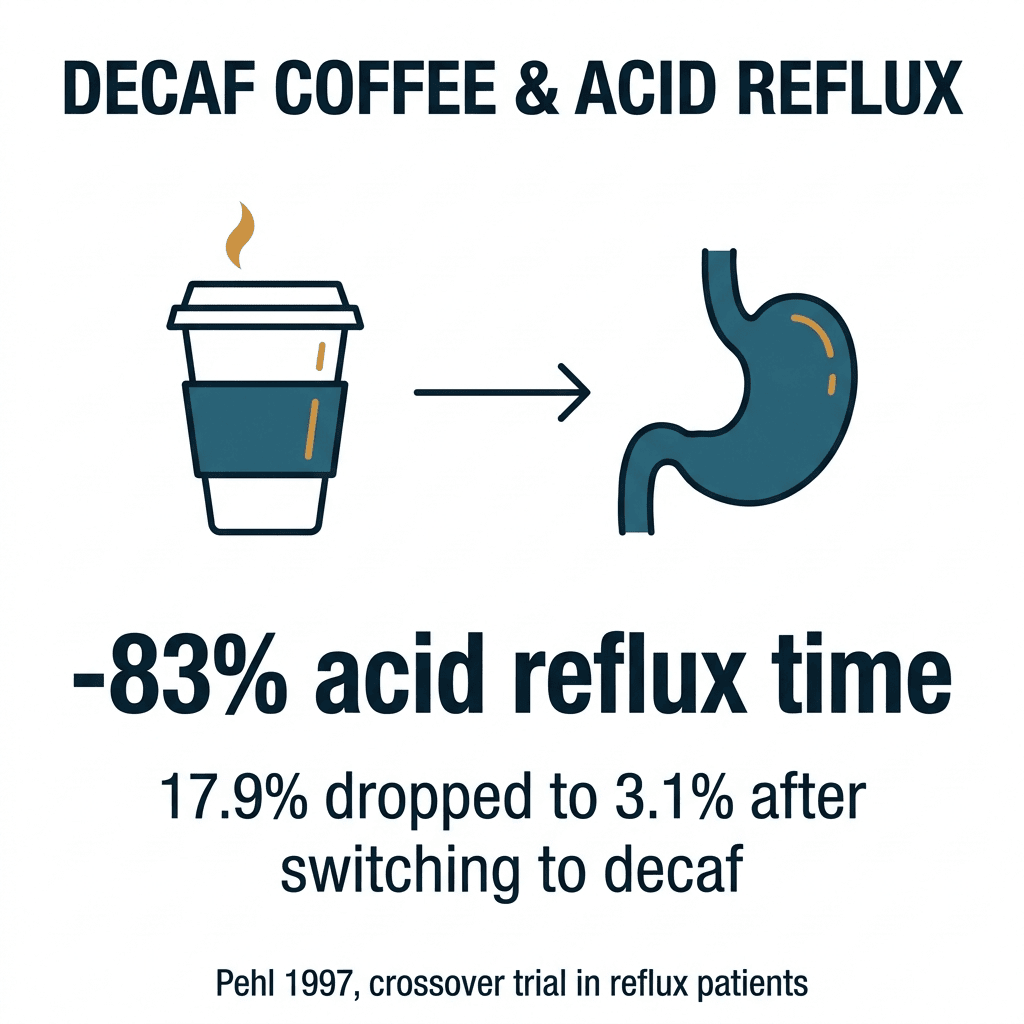
Decaf coffee is gentler on acid reflux than regular coffee. Acid reflux is the backward flow of stomach acid into the oesophagus, which clinicians quantify as the share of time oesophageal pH stays below 4. A 1997 crossover by Christian Pehl in Alimentary Pharmacology & Therapeutics tracked exactly that. In 17 reflux patients, the acid-exposure time fell from 17.9 percent after regular coffee to 3.1 percent after decaf. That is a drop of roughly 83 percent. A 1994 study by Bernd Wendl in the same journal found the reason: adding pure caffeine to water did not trigger reflux at all, so it is the other coffee compounds, the ones decaf keeps but in a gentler form, that drive the effect.
Decaf coffee's gentler profile was quantified in a 1975 dose-response study by Sidney Cohen in the New England Journal of Medicine. It measured gastric acid output at 16.5 milliequivalents an hour for decaf against 20.9 for regular. So decaf still stimulates acid, just less, rather than being inert. The effect shows up within the first three hours after a cup, the postprandial window these trials tracked. That timing is why a decaf switch matters most right after meals, when reflux tends to strike. Brew choices for decaf coffee and acid reflux are covered separately.
7. Decaf Coffee Does Not Disrupt Sleep
Decaf coffee does not disrupt sleep at its 2 to 15 mg caffeine dose. Sleep onset latency, the time it takes to fall asleep, is the standard marker caffeine lengthens, as defined in a 2007 study by Louise Paterson in Psychopharmacology. That delay grows with the caffeine dose, and it becomes measurable only around 200 to 400 mg. Decaf delivers a small fraction of it.
The caffeine in decaf coffee sits far below the sleep-disrupting doses that a 2013 study by Christopher Drake identified in the Journal of Clinical Sleep Medicine. Drake gave 400 mg of caffeine at 0, 3, and even 6 hours before bed, and all three timings disrupted sleep. That is why the authors advise cutting off caffeinated coffee at least 6 hours before bedtime. A 2006 study by Julie Carrier in Neuropsychopharmacology showed even 200 mg reduced deep sleep and lengthened the time it took to fall asleep. Against those figures, decaf's 2 to 15 mg sits 13 to 200 times lower. That is the main benefit of decaf coffee after dinner, when a regular cup would cost you sleep.
8. Decaf Coffee Lowers Anxiety and Jitter Load
Decaf coffee lowers the anxiety and jitter load by carrying too little caffeine to trigger either. The anxiogenic dose is the amount of caffeine that reliably produces nervousness and arousal, which a 1984 study by Dennis Charney established in Life Sciences. Charney gave healthy people about 10 mg per kilogram, roughly 700 mg for an adult, and saw robust increases in rated anxiety. Decaf's 2 to 15 mg sits nowhere near that.
The caffeine in decaf coffee falls tens to hundreds of times below every anxiety-provoking dose. In a double-blind challenge, 480 mg of caffeine induced panic in 52 percent of panic-disorder patients and zero percent of healthy controls, per a 2008 study by Antonio Nardi in Depression and Anxiety. Set against Charney's 700 mg healthy-person threshold and Nardi's 480 mg panic dose, a decaf cup stays 30 to 350 times lower. The anxiety and jitter of coffee are caffeine effects at adenosine and adrenergic receptors, and decaf's trace dose does not meaningfully reach them. For a coffee drinker who is prone to jitters, decaf takes the caffeine out of the equation.
For coffee lovers who dread the jitters
The panic-provoking dose in the caffeine-challenge study was 480 mg. A decaf cup holds 2 to 15 mg, tens of times below it, so the caffeine driver of jitters is gone while the ritual stays. Switch your late-day cups to decaf first.
9. Decaf Coffee Reduces Inflammation Markers
Decaf coffee reduces inflammation markers through caffeic and ferulic acids, which survive decaffeination. C-reactive protein, the main marker here, is a liver-made protein that rises with low-grade chronic inflammation and predicts cardiovascular risk, which is how a 2018 study by Barbara Stutz used it in Nutrition, Metabolism & Cardiovascular Diseases. Those acids, not the stimulant, are what lower it.
The anti-inflammatory effect of decaf coffee was measured in a 2019 study by Dong Hang in the American Journal of Clinical Nutrition, which tracked nearly 23,000 people and tied 4 or more cups a day to 16.6 percent lower C-reactive protein and 8.1 percent lower interleukin-6. Crucially, Hang reported the results were largely the same for caffeinated and decaffeinated coffee, which pins the effect on the phenolics rather than the caffeine. The immune-cell study noted earlier backs that up directly, since filtered decaf suppressed an inflammatory pathway on its own. A deeper look is covered separately.
10. Decaf Coffee Is a Safer Option During Pregnancy
Decaf coffee is a safer option during pregnancy, the practical way to cut caffeine while keeping the ritual. Caffeine crosses the placenta and reaches the fetus at close to the mother's own blood level, while the fetus can barely metabolise it. That exposure carries measurable risk. A 2014 meta-analysis by Darren Greenwood in the European Journal of Epidemiology found each extra 100 milligrams (mg) of caffeine a day raised miscarriage risk by 14 percent, stillbirth by 19 percent, and low birth weight by 7 percent. Greenwood found no safe threshold, so every 100 mg a mother cuts lowers those risks in step.
Decaf coffee is the simplest way for a pregnant woman to make that cut. A 2015 Cochrane review by Shayesteh Jahanfar compared caffeinated instant coffee against decaf across roughly 1,200 women in later pregnancy, and switching to decaf lowered caffeine intake by an average 182 mg a day. That 182 mg is about the caffeine in two regular cups, the amount Greenwood's data linked to a meaningfully higher miscarriage and stillbirth risk. Cutting it drops a woman well under the 200 mg daily ceiling the American College of Obstetricians and Gynecologists sets. So the swap would be expected to reverse most of the added risk, though these are population associations, not a promise for any one pregnancy. Among the benefits of decaf coffee for women, this pregnancy-safe swap is the best-evidenced. The trimester-by-trimester detail on decaf coffee during pregnancy is covered separately.
Pregnancy: stay under 200 mg caffeine a day
Each 100 mg of caffeine a day was linked to a 14 percent higher miscarriage risk in a 2014 meta-analysis. A 2015 Cochrane review found switching to decaf trimmed intake by 182 mg a day, which keeps a coffee habit well under the 200 mg pregnancy ceiling.
How Many Cups of Decaf Coffee a Day?
You can drink 5 or more cups of decaf coffee a day with no progressive caffeine risk. Each cup holds only 2 to 15 mg of caffeine. Even 5 cups deliver 10 to 75 mg total, below a single cup of regular coffee. The practical ceiling comes from brew method and additives, not the caffeine.
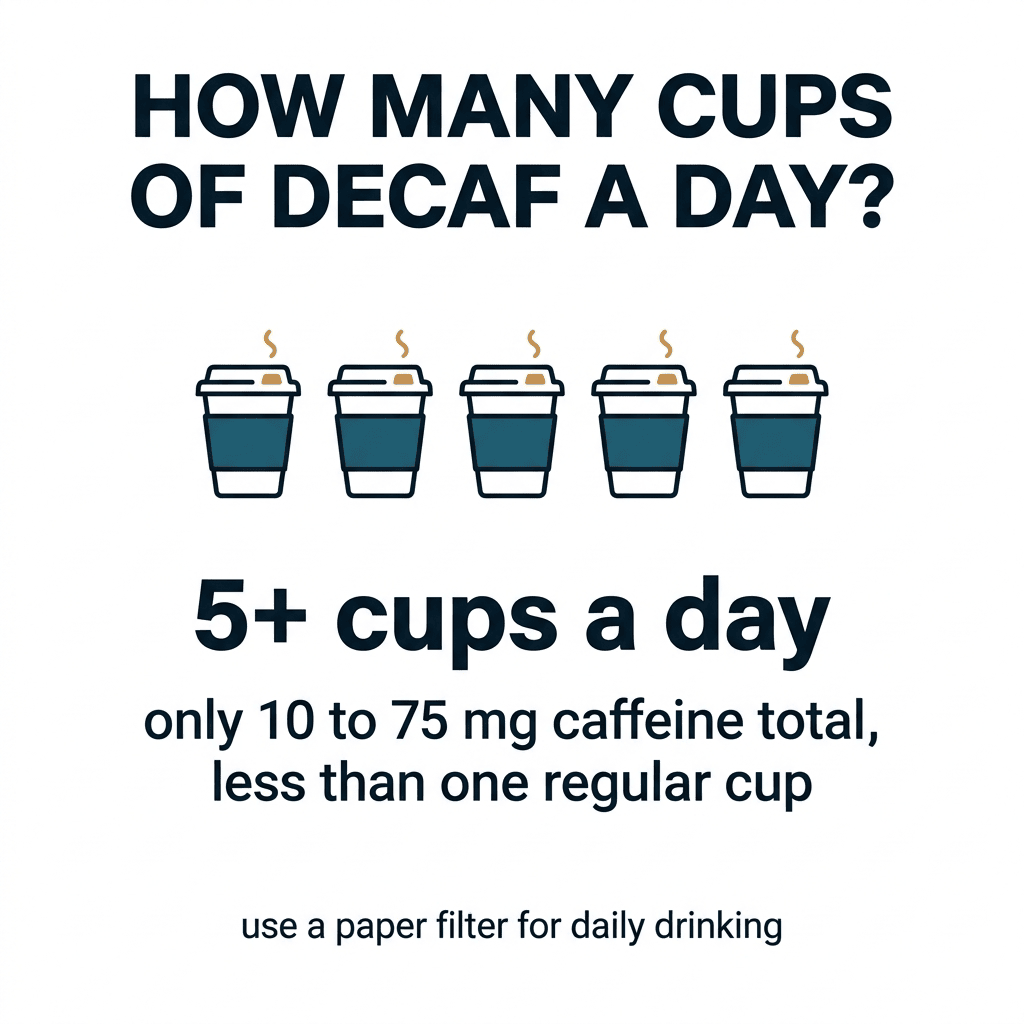
The one limit on daily decaf coffee is the brew, not the dose. In unfiltered decaf, the diterpene cafestol can raise cholesterol at high volume. A paper filter removes that concern, so filtered decaf drinkers can comfortably take several cups a day. For most people, the benefits of drinking decaf coffee everyday come from that steady antioxidant intake, not from caffeine.
Is It OK to Drink Decaf Every Day?
Yes. Decaf coffee is safe for daily consumption for most adults. The residual 2 to 15 mg of caffeine per cup poses no accumulation risk, and coffee's antioxidant benefits accrue with regular intake. Daily filtered decaf is a sound habit.
Is Decaf Coffee Safe to Drink Every Day?
Yes. Daily decaf coffee is safe for the general adult population, and that covers many caffeine-sensitive drinkers. The one method-specific caveat is unfiltered brewing, where cafestol raises cholesterol over time. A paper filter resolves it.
What Are the Side Effects of Drinking Decaf Coffee?
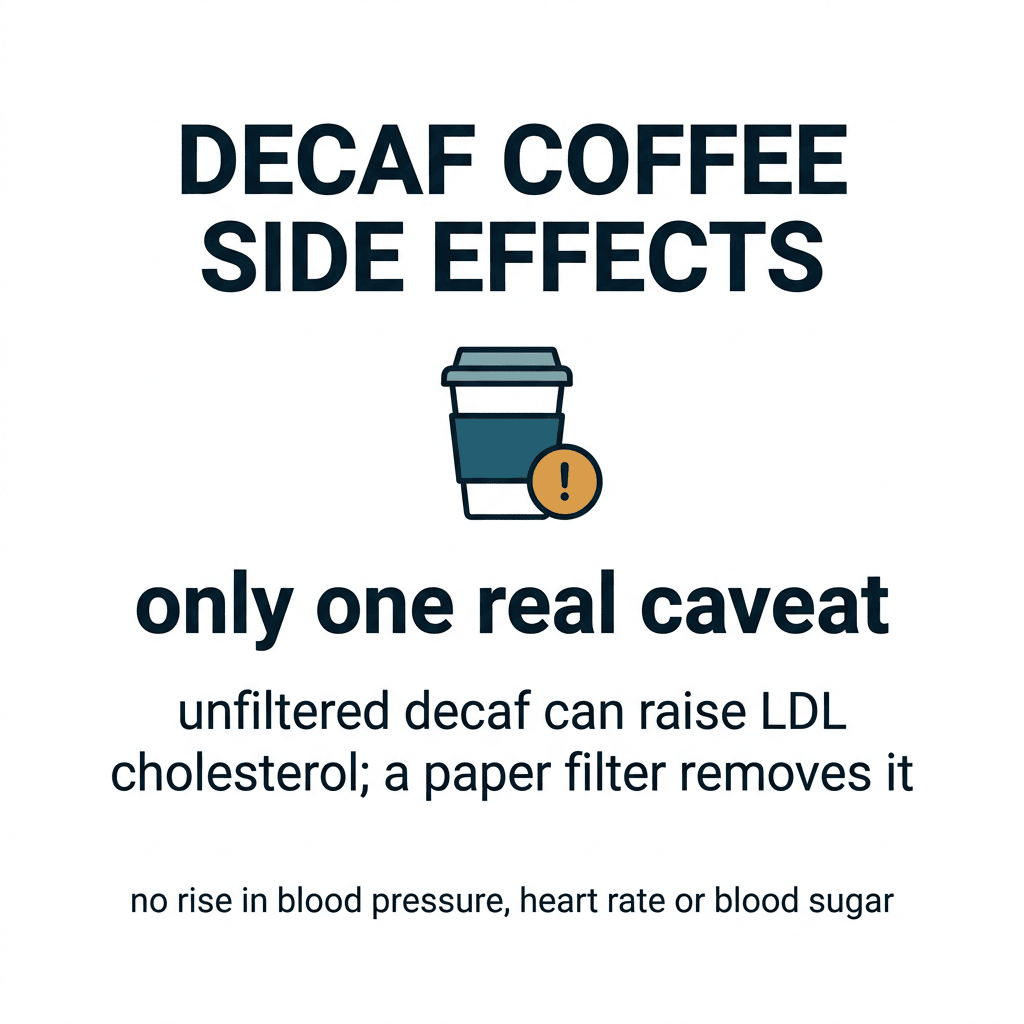
Most feared side effects of decaf coffee are specific to unfiltered brewing or arise only from the caffeine decaf largely lacks. Decaf does not raise blood pressure, heart rate, or blood sugar in controlled data. The two genuine caveats are cafestol in unfiltered decaf, which raises cholesterol, and histamine, which matters for histamine-intolerant drinkers. The section below runs each claim against its evidence.
Does Decaf Coffee Raise Blood Pressure?
No. Decaf coffee does not raise blood pressure above water-baseline values. A 2022 crossover study by Alhabeeb tested 40 participants in the Pakistan Journal of Biological Sciences. Neither caffeinated nor decaffeinated coffee changed blood pressure at 30 to 90 minutes. The acute pressor effect is a caffeine effect, and decaf lacks the dose.
Does Decaf Coffee Increase Heart Rate?
No. A cup of decaf does not increase heart rate, and it produces slightly lower mean arterial pressure than regular coffee. In a crossover study of 16 participants, decaf gave 100 mmHg against 103 for regular, per a 2023 study by Butler in Clinical Autonomic Research. The cardiovascular stimulation people associate with coffee tracks the caffeine, not the bean.
Does Decaf Coffee Raise Cortisol?
No evidence says it does. No controlled study has tested decaffeinated coffee's specific effect on cortisol, and the decaf-specific data simply does not exist. Since cortisol elevation from coffee is a caffeine-mediated effect, and decaf carries only 2 to 15 mg, a meaningful cortisol response is unlikely.
Does Decaf Coffee Raise Blood Sugar?
No. Decaf coffee lowers, rather than raises, blood sugar in controlled trials. It improved insulin sensitivity in healthy men and cut fasting glucose in type-2 diabetes patients, as covered in the blood-sugar benefit above. Decaf sits on the glucose-lowering side of the ledger. The full mechanism is in the blood-sugar article.
Does Decaf Coffee Raise LDL Cholesterol?
Yes, but only unfiltered. Decaf coffee raises LDL cholesterol when brewed without a paper filter, because the diterpene cafestol survives. A 1997 crossover study by Rob Urgert gave 10 men cafestol at 61 to 64 mg a day. LDL rose by 22 milligrams per decilitre (mg/dl), per the American Journal of Clinical Nutrition. Paper-filtered decaf removes cafestol and this effect, so any paper-filtered brew is safe for cholesterol. Brew choices are covered separately.
Does Decaf Coffee Raise Histamine?
Yes, modestly. Decaf coffee contains measurable histamine, like all coffee. A 2014 study by Restuccia in Food Chemistry found histamine in roasted ground coffee and brewed beverages. Content fell as roast degree rose. For most people this is negligible, and only drinkers with diagnosed histamine intolerance need to track it. For them, decaf coffee is genuinely relevant and worth monitoring.
What Happens to Your Body When You Switch to Decaf?
What happens in your body when you switch to decaf is that caffeine-blocked adenosine receptors readjust. Habitual caffeine keeps these receptors in chronic blockade. When the dose drops to decaf levels, they return to baseline sensitivity over several days. That readjustment is the transition period.
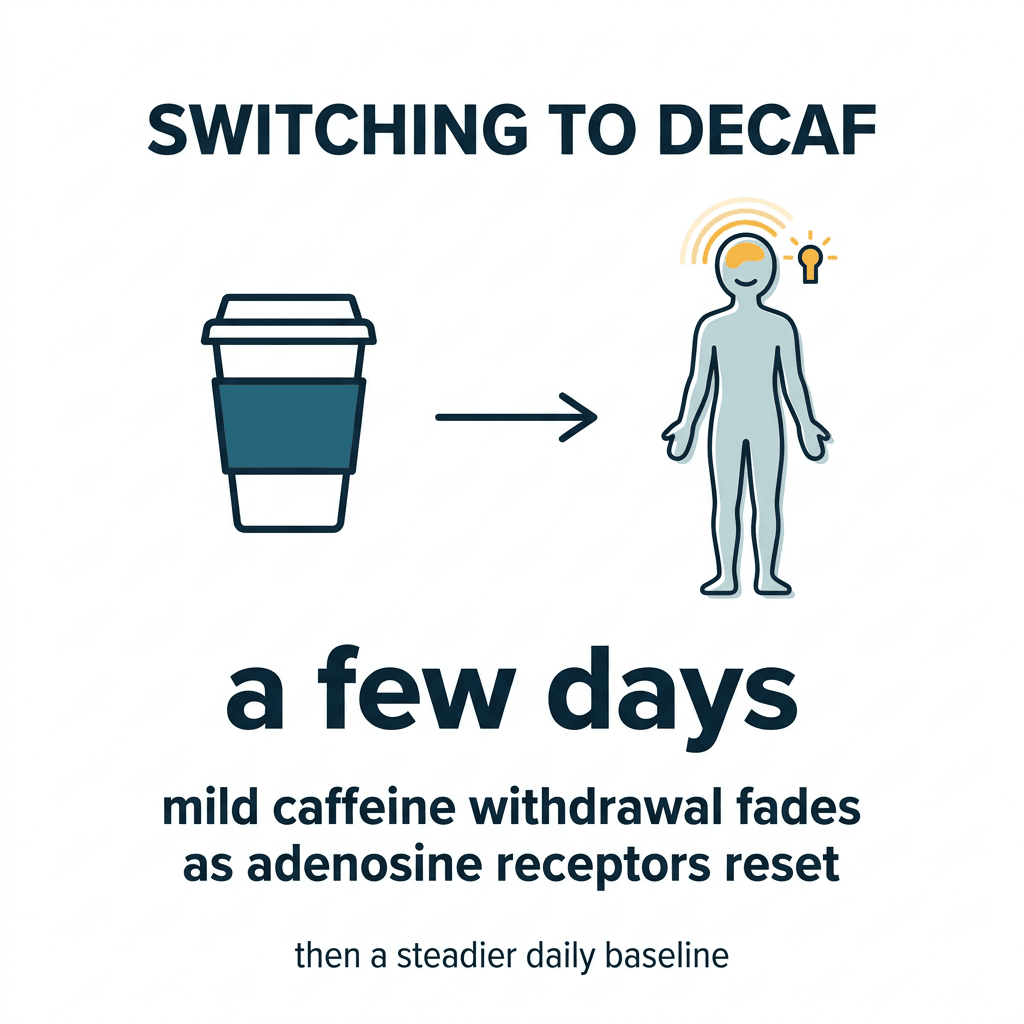
The switch to decaf brings one short-term effect for most people: caffeine withdrawal. Headache, lower alertness, and fatigue can last a few days as the body adapts, then fade as adenosine signalling normalises. After that, decaf drinkers keep the coffee ritual and coffee's antioxidant benefits without the caffeine cycle. The switch trades a short adaptation for a steadier daily baseline.
Does Decaf Coffee Have the Same Health Benefits As Regular Coffee?
Mostly, yes: decaf coffee shares most of the same health benefits as regular coffee. The liver, glycemic, and anti-inflammatory effects come from antioxidants that survive decaffeination, so they carry over. The benefits tied specifically to caffeine, like acute alertness and endurance, do not.
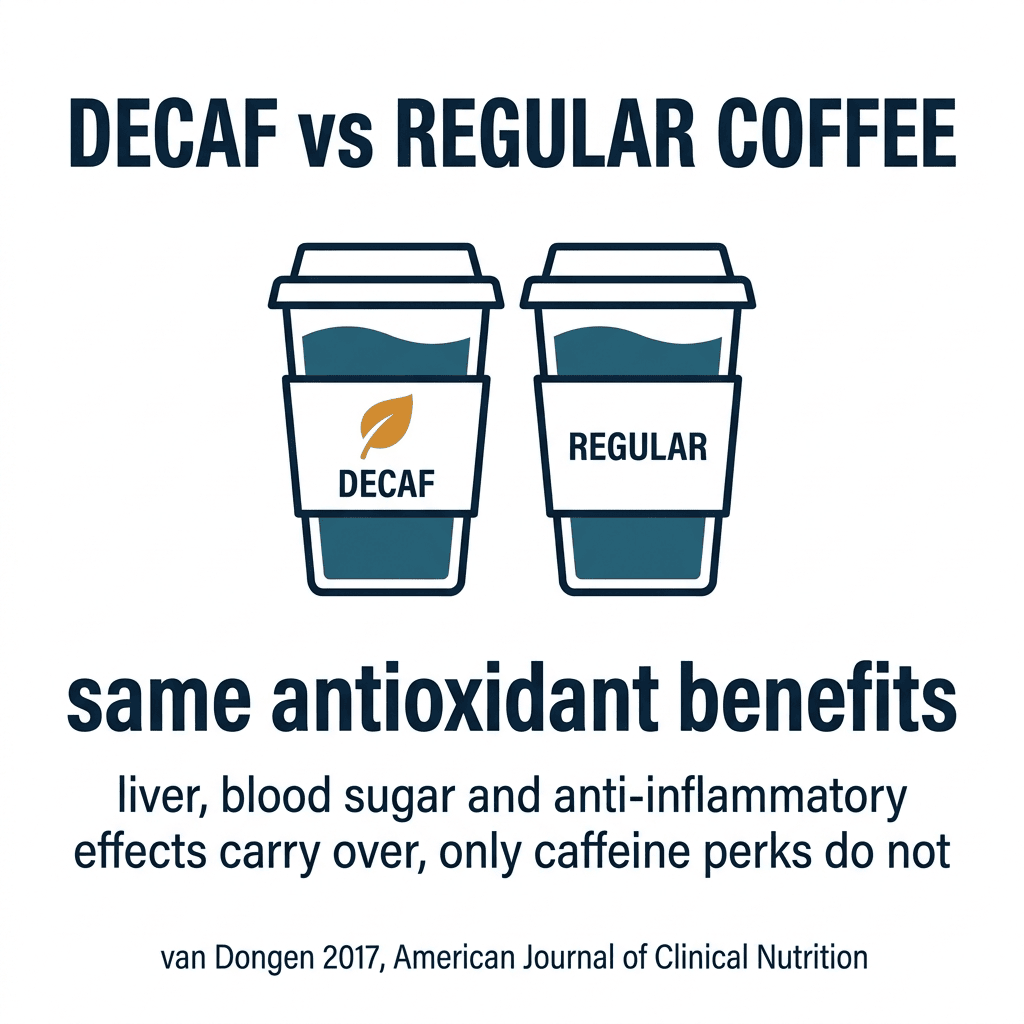
The health benefits of decaf black coffee split along one line: mechanism. Phenolic benefits transfer to decaf, and caffeine benefits do not. A 2017 study by van Dongen in the American Journal of Clinical Nutrition linked coffee intake to lower cardiovascular mortality in post-heart-attack patients. It reported similar associations for decaf. So the cardiovascular and metabolic upside largely holds without the stimulant.
Does Decaf Coffee Give You Energy?
No. A cup of decaf coffee does not deliver pharmacological energy the way caffeine does. Its 2 to 15 mg of caffeine per cup is too low to block adenosine receptors and produce measurable alertness. Any lift comes from warmth, aroma, and the ritual expectation of a coffee break, not from a stimulant dose.
The lift people feel from decaf coffee is genuine, even without the chemistry behind it. Decaf offers the sensory and psychological cues of a coffee break, which can steady focus through a mid-afternoon slump. What it will not do is override real sleep debt the way a caffeinated cup can. For steady, low-key energy without a crash, that trade works in decaf's favour.
Is Decaf Coffee Still a Stimulant?
No. Decaf coffee is not a meaningful stimulant. A beverage acts as a stimulant when its caffeine content substantially blocks adenosine receptors. Decaf's 2 to 15 mg per cup does not reach that threshold, so it produces no significant central-nervous-system stimulation.
The trace caffeine in decaf coffee is pharmacologically present but functionally negligible. For comparison, a therapeutic caffeine dose starts near 40 mg, and decaf sits well below even one cup's worth of that. Decaf is best classed as a low-caffeine drink, not a stimulant.
Does Decaf Coffee Help With Weight Loss?
The benefits of decaf coffee for weight loss work through appetite and glycemic effects rather than caffeine-driven metabolism. Its chlorogenic acid improves insulin sensitivity, and the near-zero calorie count makes it a useful swap for sweetened drinks.
What Are the Benefits of Decaf Coffee for Skin?
Decaf coffee supplies antioxidant polyphenols that support skin without the caffeine. Chlorogenic acid, which survives decaffeination, helps neutralise the oxidative stress linked to skin ageing. Topical and dietary antioxidant intake both contribute, so decaf offers the antioxidant benefit while avoiding caffeine's dehydrating reputation.
What Are the Nutritional Benefits of Decaf Coffee?
Black decaf coffee is a near-zero macronutrient drink. A 236 ml (8 fl oz) cup holds about 2 to 5 calories, under 1 gram of carbohydrate, no sugar, and no fat. Its nutritional value comes less from macronutrients than from its potassium, magnesium, and antioxidants. The caffeine sits at 2 to 15 mg per cup.
How Many Calories Are in a Cup of Decaf Coffee?
A 236 ml (8 fl oz) cup of black decaf coffee holds about 2 to 5 calories, and a larger 355 ml (12 fl oz) serving stays under 8. Those calories come from trace soluble compounds in the bean, not from carbohydrate or fat. Milk, cream, or sugar add the rest, so on its own black decaf is effectively calorie-free.
Does Decaf Coffee Have Carbs?
Black decaf coffee contains close to zero carbohydrates, under 1 gram per 236 ml (8 fl oz) cup. The trace amount comes from dissolved plant compounds. Added milk or syrup introduces the carbs, so a black cup fits low-carb and keto patterns.
Does Decaf Coffee Have Sugar?
No. Black decaf coffee contains no sugar. The bean carries no free sugars into the brewed cup. Any sugar in a decaf drink comes from what is added after brewing, so an unsweetened black cup has zero grams. The health benefits of drinking black decaf coffee without sugar follow from that: the antioxidants arrive with no empty calories.
Does Decaf Green Tea Share the Same Benefits?
Decaf green tea delivers its own polyphenol profile, led by catechins like epigallocatechin gallate (EGCG) rather than coffee's chlorogenic acid. Both keep most antioxidants after decaffeination, but the compounds differ, so the specific benefits diverge.
Is Decaf Coffee Beneficial During Pregnancy?
Decaf coffee lets a pregnant woman cut caffeine by about 182 mg a day while keeping the ritual, per the 2015 Cochrane review. That keeps intake well under the 200 mg pregnancy ceiling. The trimester detail on decaf coffee during pregnancy is covered separately.
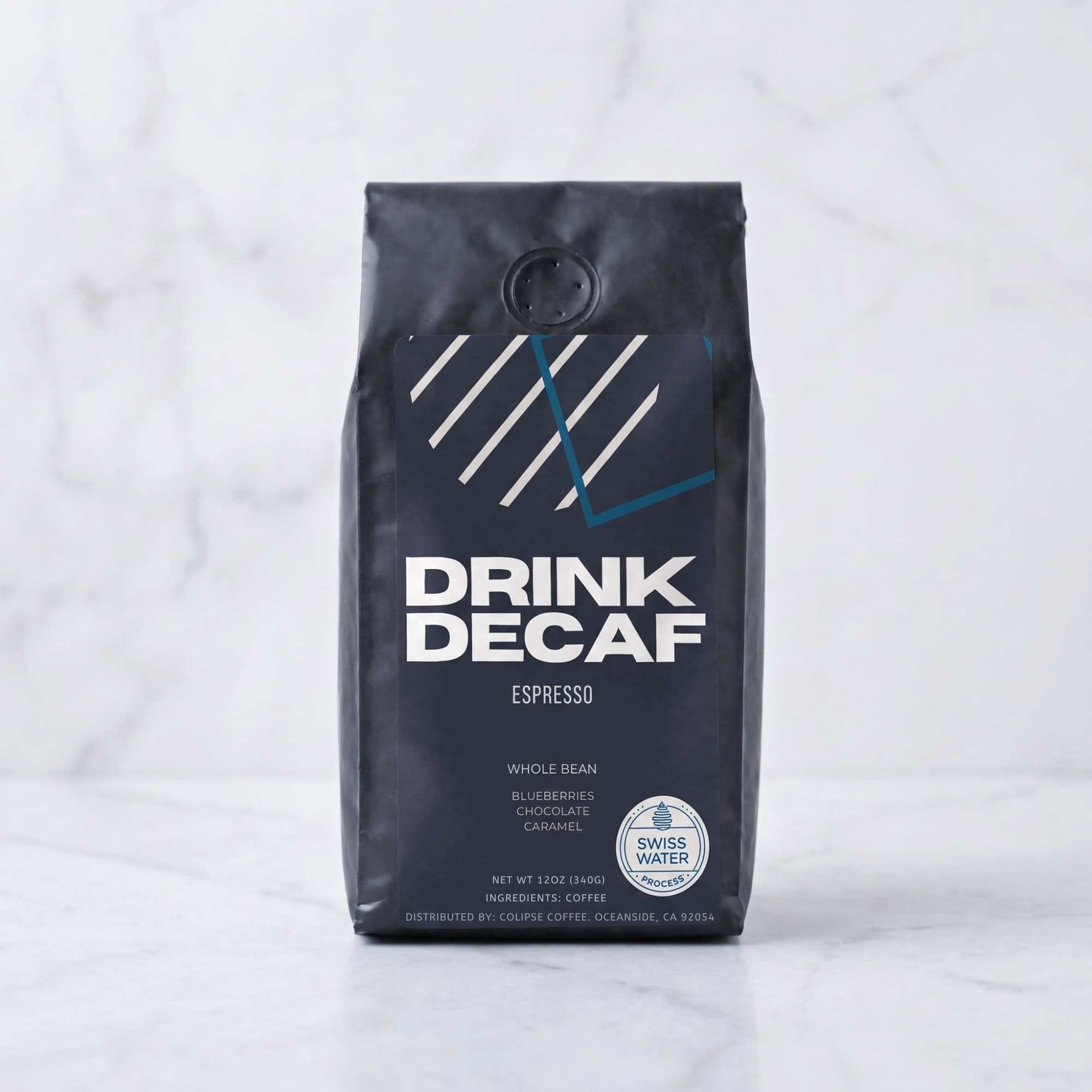
12 oz · Whole bean
Drink Decaf EspressoSpecialty grade. Swiss Water Process® decaffeinated. Roasted to order at our California roastery. Blueberry, chocolate, caramel.
Free shipping in the US